

Digitizing yacht club operations is the fastest path to reducing volunteer burnout, eliminating recurring billing errors, and delivering a modern member experience. The short answer: yes, you should digitize, and the three areas that pay off fastest are member self-service portals, integrated billing, and slip/waitlist automation. Clubs that consolidate these into a single platform stop spending staff hours on manual reconciliation and start recovering revenue that paper-based processes routinely miss.
Here is what that looks like in practice:
- Member self-service: Members view charges, pay invoices, upload insurance certificates, and register for events without calling the office.
- Integrated billing: Autopay, Stripe/ACH processing, and QuickBooks sync replace manual entry and end-of-month scrambles.
- Slip and waitlist automation: Interactive marina maps, real-time occupancy, and automated waitlist notifications replace spreadsheets and phone tag.
- Document expiry alerts: Automated flags for lapsing insurance or vessel registration prevent the club from operating with outdated records.
Quick next step: Scope a 30–60 day pilot covering the member portal, slip assignments, and recurring billing. That scope is narrow enough to launch fast and broad enough to show the board measurable results.
Table of Contents
- What operational benefits does digitizing a yacht club actually deliver?
- Which platform features actually move the needle for yacht clubs?
- Where do clubs usually see the payoff first?
- What should you watch for when choosing a platform?
- What does a realistic rollout look like, and what drives cost?
- How Atlantis Marina addresses these needs in practice
- Key Takeaways
- The case for moving now, not later
- Atlantis Marina brings it all together for your club
- Useful resources and next reads
- FAQ
What operational benefits does digitizing a yacht club actually deliver?
Fragmented systems cost clubs more than most managers realize. Facilities using disconnected systems spend a significant amount of weekly time on manual data reconciliation, producing billing errors and unreliable reporting. That is nearly half a full-time position consumed by tasks a unified platform handles automatically.

Time savings show up immediately. Renewal reminders, event signups, and payment reconciliations run on schedule without staff intervention. Automating admin workflows reduces volunteer workload and helps retain committee members by removing repetitive tasks like manual approvals and member communications.

Accuracy and auditability improve because every transaction lives in one record. Automated utility billing eliminates manual meter-reading errors, and sub-lease income becomes a trackable, auditable stream rather than a figure someone reconstructs from notes at year-end.
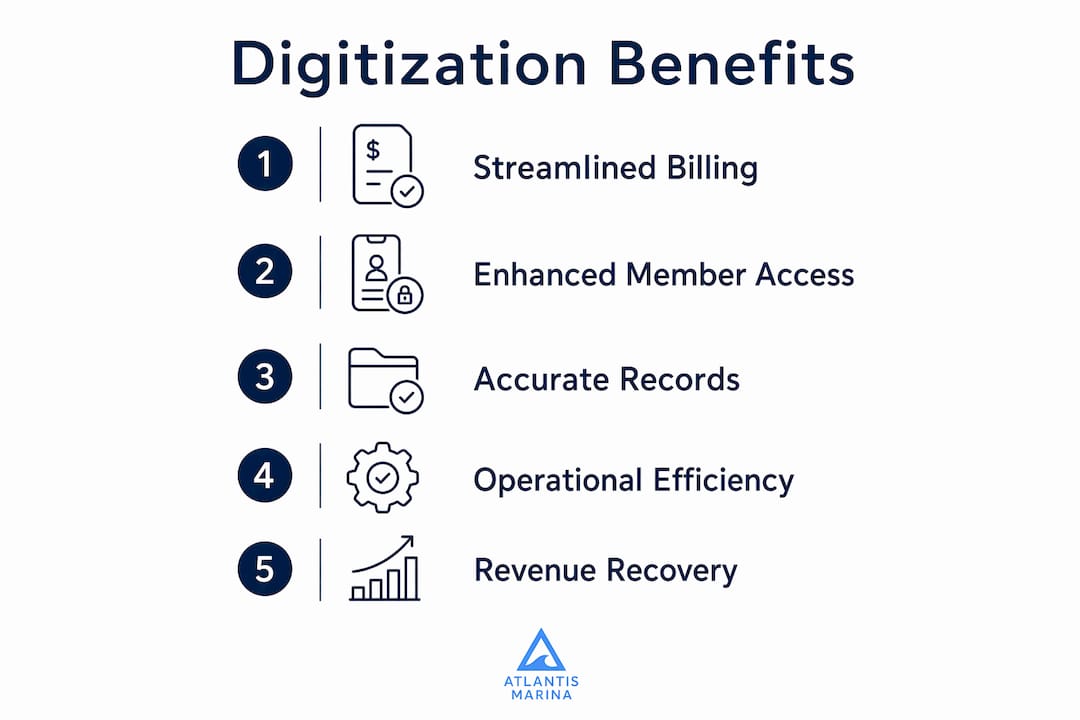
Member experience rises when self-service is available. A dock-to-deck digital experience where members view itemized charges, pay invoices, and manage reservations drives higher event participation and more reservations because engagement is easier. A centralized membership system can support hundreds of members without increasing admin burden — some clubs have used a centralized platform to scale while reducing administrative work.
Revenue recovery follows naturally. POS charges, metered utilities, and sub-lease income become auditable once they flow through a single system. Governance also tightens: granular role-based permissions let committees operate with the correct view and edit access without exposing sensitive financial data to the wrong people.
Which platform features actually move the needle for yacht clubs?
The benefits above depend on specific capabilities working together. Here is how the core feature areas map to operational outcomes:
| Feature Area | Primary Outcome | Key Capabilities |
|---|---|---|
| Membership management | Reduced admin hours | Profiles, renewal automation, member categories, committee approvals |
| Slip and moorage management | Fewer disputes, better occupancy | Interactive maps, assignments, waitlists, sub-lease tracking |
| Billing and payments | Faster close, fewer errors | Recurring billing, autopay, Stripe/ACH, QuickBooks sync, POS integration |
| Events and regattas | Higher attendance, cleaner revenue | Online registration, volunteer sign-ups, waivers, ticketing |
| Member self-service | Fewer inbound calls | Web/mobile portal, invoice access, document uploads, e-sign contracts |
| Hardware integrations | Automated metering and access | Access control, water/electric meters, cameras, boat-lift controllers |
| Reporting and analytics | Informed decisions | Occupancy, revenue, utilization, compliance alerts |
A few of these deserve extra attention:
- Membership management: A platform that handles applications, approvals, renewals, and communications in one place scales without adding staff. Member portal setup is the first configuration step that pays dividends across every other module.
- Billing and payments: Recurring billing automation with autopay and QuickBooks sync eliminates the manual entry loop that causes most month-end errors.
- Events and regattas: Integrated event registration tied to membership records and POS improves registration accuracy and drives higher post-event revenue through targeted follow-up communications.
- Hardware integrations: Access control, metered utilities, and camera feeds connected to the platform turn physical infrastructure into data. Automated billing for metered water and electric removes manual meter-reading reconciliation entirely.
- Document management: Automated alerts for expiring insurance certificates and vessel registrations are a risk-mitigation tool, not just an admin convenience. A club operating with lapsed documentation carries real liability.
Where do clubs usually see the payoff first?
The sequence of benefits after launch tends to follow a predictable pattern, and knowing it helps you set realistic expectations with your board.
First 30–90 days: Billing calls to the office drop as members access itemized invoices through the portal. Month-end close gets faster because POS and billing data live in the same system. Consolidating POS with member billing significantly reduces time spent on monthly closing and reconciliation. Online invoice payments increase as members find the portal easier than mailing checks.
90–180 days: Event attendance climbs because online registration removes friction. Volunteer admin time falls as automated workflows handle signups, reminders, and approvals. Berth availability becomes visible in real time on an interactive map, replacing the spreadsheet that was always slightly out of date.
Concrete before/after examples:
- Manual event ticketing required a volunteer to collect registrations by email, build a list, and reconcile payments. Online registration with integrated payment processing handles all three automatically.
- Spreadsheet berth lists required the dockmaster to cross-reference multiple files to answer a simple availability question. An interactive marina map with live occupancy answers it in seconds.
- Paper meter readings introduced transcription errors and billing disputes. Automated metered billing connected to real-time sensor data eliminates both.
The clubs that see the fastest payoff are those that launch the member portal and billing integration together. Members adopt the portal quickly when it offers immediate value: itemized transaction histories and document uploads are the two features that drive early login rates.
What should you watch for when choosing a platform?
Vendor evaluation is where clubs make expensive mistakes. A platform that looks complete in a demo can hide fragmented data architecture, opaque payment fees, or permission models too blunt for committee governance.
Evaluation checklist — must-have dimensions:
- Feature coverage: Does the platform handle membership, slips, billing, events, and POS in a single database, or does it sync between separate systems? Single-database architecture avoids the data lag and reconciliation issues common to API-synced stacks.
- Integrations: QuickBooks sync, Stripe/ACH payment processing, and hardware compatibility (access control, meters, cameras) should be native, not bolted on.
- Security and permissions: Granular, domain-specific roles for committees (sailing, house, treasurer) with audit logs for member status changes. Two roles — admin and member — is not enough for a club with multiple committees.
- Support and onboarding: Ask for a documented implementation timeline, a data migration sample, and reference contacts from clubs of similar size.
Questions to ask every vendor:
- Is this a single database or an API sync between separate products?
- What is the typical implementation timeline for a club our size?
- What does data migration support include, and what do we need to prepare?
- How do volunteer committee members access the system without seeing financial data they shouldn't?
- Which hardware manufacturers does the platform support natively?
Red flags to watch for:
- Fragmented data across multiple disconnected systems with no single source of truth.
- Opaque per-transaction fees for payments or hardware that aren't disclosed upfront.
- Permission controls limited to admin/member with no committee-level granularity.
- No documented data protection or PCI compliance approach for payment processing.
- Vague onboarding commitments with no SLA or named implementation contact.
Procurement notes: Request a proof-of-concept scoped to member portal, billing, and slip management. Ask for a data migration sample using a subset of your actual member records. Check references from at least two clubs with similar berth counts and governance structures.
What does a realistic rollout look like, and what drives cost?
| Phase | Typical Duration | Key Activities |
|---|---|---|
| Discovery and scoping | 1–2 weeks | Requirements review, data audit, hardware inventory |
| Data migration | 1–3 weeks | Member records, vessel data, billing history |
| Configuration | 1–2 weeks | Roles, permissions, billing rules, slip maps |
| Pilot launch | 30–60 days | Member portal, billing, slips — limited user group |
| Full launch | 1–2 weeks | All modules, all members, staff training complete |
| Steady-state optimization | Ongoing | Reporting review, workflow refinements, hardware additions |
Timeline by club size:
- Small club (under 150 members): 4–8 weeks from kickoff to pilot launch.
- Medium club (150–400 members): 8–12 weeks, especially if hardware integrations are in scope.
- Large or complex club (400+ members, multiple committees, hardware): 12–20+ weeks.
Major cost drivers:
- Data migration complexity: clubs with years of records across multiple spreadsheets take longer and cost more to migrate than clubs with a single clean export.
- Custom hardware integrations: access control systems, utility meters, and cameras that require custom connectors add time and cost.
- Training scope: staff-only training is faster; training that includes volunteer committee members and a member portal rollout campaign takes longer.
- Optional hardware purchases: new POS terminals, smart lift controllers, or camera systems are capital expenses separate from the software subscription.
Tips to control cost: Scope the pilot narrowly (member portal, billing, slips only). Reuse existing hardware where the platform supports it. Plan phased rollouts by function rather than trying to go live on all modules simultaneously. A facility upgrade checklist helps identify which infrastructure is reusable before you commit to hardware purchases.
How Atlantis Marina addresses these needs in practice
Atlantis Marina is built on a single unified database, which means a member record update cascades automatically to billing, marina maps, and access control lists without manual re-entry. That architecture is the operational foundation that prevents the data lag and reconciliation errors that plague clubs running multiple disconnected tools.
Concrete operational flows:
- A member updates their vessel insurance through the Atlantis Boater App. That update reflects immediately in the club's document records, billing account, and access control status.
- Slip assignments update the interactive marina map in real time. The dockmaster sees live occupancy without refreshing a spreadsheet.
- Metered water and electric consumption bills automatically to member accounts, eliminating manual meter reads and the disputes that follow them.
Before/after operational metrics (illustrative):
| Metric | Before Digitization | After Digitization |
|---|---|---|
| Monthly reconciliation time | 15–20 hrs/week | Significantly reduced |
| Invoice disputes per month | Frequent, manual resolution | Fewer, self-service resolution |
| Event registration process | Manual email/spreadsheet | Online, integrated with billing |
| Document expiry tracking | Ad hoc, often missed | Automated alerts, audit trail |
Pro Tip: Start your pilot with the member portal and billing integration running together. Members who can see their own invoices and pay online stop calling the office within the first billing cycle. That single change is usually enough to win over skeptical board members.
Atlantis Marina also supports marina billing with Stripe and ACH processing, QuickBooks Online sync, autopay, and Atlantis E-Sign for contracts. The ship store POS integrates with member accounts so every on-site purchase posts to the correct record automatically. For clubs with physical infrastructure, the platform connects to smart boat lift controllers, utility meters, access control systems, and security cameras through a single operations dashboard.
Key Takeaways
Digitizing yacht club operations delivers the clearest, fastest return when member portals, recurring billing, and slip automation launch together in a scoped 30–60 day pilot.
| Point | Details |
|---|---|
| Start with a narrow pilot | Scope member portal, billing, and slips first to show measurable ROI within 60 days. |
| Single database matters | Platforms built on one unified database avoid the many hours per week lost to manual reconciliation. |
| Volunteer relief is a primary goal | Automating renewals, approvals, and communications preserves committee energy for community work. |
| Permissions must match governance | Granular committee-level roles with audit logs are required for clubs with multiple committees. |
| Atlantis Marina unifies the stack | Atlantis Marina connects memberships, slips, billing, POS, hardware, and the Boater App in one platform. |
Immediate action checklist:
- Identify your data steward (board treasurer, operations lead, or IT contact) before scoping begins.
- Audit your current member records and vessel data for migration readiness.
- Schedule vendor demos focused specifically on single-database workflows and committee permission models.
- Involve your volunteer coordinator early to plan the member portal rollout campaign.
- Prioritize member portal, recurring billing, and slip/waitlist automation as your pilot scope.
The case for moving now, not later
The argument for delaying digitization usually comes down to two concerns: the disruption of change and the cost of the platform. Both are real, but they tend to be overstated relative to the cost of staying manual.
What gets underestimated is the cultural side of the transition. Software does not fix a club where committee members distrust each other's data, or where the treasurer has been the sole keeper of billing records for a decade. The technology is the easy part. The harder work is agreeing on a single source of truth and getting every committee to use it. Clubs that skip this conversation during scoping often find themselves six months post-launch with a platform that is technically live but behaviorally ignored.
The staged rollout approach addresses this directly. When you launch the member portal first and let members experience the self-service benefits before you touch committee workflows, you build internal advocates before you ask anyone to change how they work. That sequencing matters more than the platform you choose.
One more thing worth saying plainly: the clubs most resistant to digitization are often the ones with the most to gain. A club running 400 members on spreadsheets and email is not managing complexity well — it is absorbing it silently through volunteer burnout and billing disputes that never get formally counted. The 15–20 hours per week lost to manual reconciliation is not a line item on anyone's budget, but it is real labor that someone is doing for free.
Atlantis Marina brings it all together for your club
Yacht clubs that want a single platform covering memberships, slip management, billing, POS, hardware integrations, and member self-service have a clear option in Atlantis Marina. The platform eliminates the fragmented-systems problem at its root: one database, one operations dashboard, and one member-facing app that handles reservations, payments, document uploads, and communications.
The practical next step is a scoped pilot covering your member portal, recurring billing, and slip assignments. Atlantis Marina's onboarding team works with clubs to scope the pilot, migrate a data sample, and configure roles and permissions before go-live. You can review pricing and plan details to understand subscription tiers, or go straight to scheduling a demo to walk through the platform with your specific club size and feature needs in mind.
Useful resources and next reads
The resources below are worth bookmarking as you move from evaluation to implementation.
Atlantis Marina product and feature pages:
- Marina management overview — single-database architecture and full feature set
- Marina billing software — QuickBooks sync, Stripe/ACH, autopay, and invoicing details
- Atlantis Boater App — member self-service, reservations, and document management
- Yacht club billing system explained — billing architecture and reconciliation examples
- Member communication tools guide — email/SMS workflows and automation triggers
- Marina customer portal explained — portal features, adoption tactics, and reporting
Industry reading:
- How Lloyd's Yacht Club simplified membership management — a real example of scaling to 660+ members with a centralized system
- Why sailing club management software matters in 2026 — volunteer retention and workflow automation context
- Yacht club software guide for modern club managers — independent overview of evaluation criteria and platform categories
FAQ
What is the point of digitizing a yacht club?
Digitizing yacht club operations replaces manual spreadsheets, paper invoices, and disconnected systems with a single platform that automates billing, member renewals, slip management, and event registration. The primary gains are reduced admin hours, fewer billing errors, and a better member experience.
How long does it take to implement yacht club management software?
A small club can complete a pilot in a few weeks; medium clubs typically need a couple of months, and larger or more complex clubs with hardware integrations should plan for several months from kickoff to full launch.
What features should a yacht club management platform include?
At minimum: membership management with renewal automation, slip and waitlist management, recurring billing with Stripe/ACH and QuickBooks sync, event registration, a member self-service portal, and granular committee-level permissions with audit logs.
Who manages a yacht club's digital platform day to day?
Day-to-day platform management typically falls to the marina operations lead or club administrator, with the board treasurer overseeing billing configuration. Committee members access their relevant modules through role-based permissions without needing full admin access.
Can Atlantis Marina handle both billing and slip management for a yacht club?
Yes. Atlantis Marina operates on a single unified database that connects slip assignments, member accounts, recurring billing, POS, and the Boater App, so updates in one area cascade automatically across the platform without manual re-entry.