

The most effective yacht club event reservation workflow combines a unified digital platform with member self-service and a centralized staff dashboard. For clubs ready to move beyond spreadsheets and email chains, the recommendation is clear: pilot a single platform that handles reservations, billing, contracts, and check-in in one place.
Top three picks for 2026:
- Atlantis Marina — the recommended unified platform for yacht clubs and marinas that need slip reservations, event booking, automated billing via Stripe and ACH, QuickBooks Online sync, and smart hardware support in one cloud-based system.
- Enterprise unified platform (e.g., full club management suites with member portals) — suitable for large, commercially operated clubs that need deep membership management alongside event scheduling.
- Lightweight scheduling add-on (e.g., standalone appointment or event registration tools) — a viable short-term option for small volunteer-run clubs under 30 active bookings per month.
Though integration gaps tend to surface quickly.
Table of Contents
- What does a yacht club event reservation workflow actually cover?
- Per-platform reviews: where does each option fit best?
- How we evaluated event reservation workflow tools
- How to choose the right event reservation workflow for your club
- Implementation timeline and pricing: what to expect
- How regatta, multi-session, and social event workflows differ
- Essential integrations and payment flows for event reservations
- How Atlantis Marina handles a full yacht club event workflow
- Key Takeaways
- Why unified workflows are the only real answer for yacht clubs
- Atlantis Marina covers your full event reservation workflow
- Useful sources and further reading
- FAQ
What does a yacht club event reservation workflow actually cover?
| Feature Dimension | Atlantis Marina | Enterprise Unified Platform | Club Management Suite | Scheduling Add-On |
|---|---|---|---|---|
| Best for | Mid-to-large clubs, marinas, dry stack operators | Large commercialized clubs | Mid-size member-funded clubs | Small volunteer-run clubs |
| Event registration | RSVPs, guest passes, group registration, intake forms | Full registration with custom fields | Member event sign-ups, waitlists | Basic RSVPs, limited custom forms |
| Reservation types | Slips, docks, dry stack, facility spaces, boat lifts | Facility spaces, rooms | Facility spaces, equipment | Rooms, time slots |
| Payments & billing automation | Autopay, Stripe, ACH, e-sign contracts, refunds, QuickBooks sync ✓ verified: autopay, QuickBooks sync | Invoicing, partial automation | Member dues + event fees | Payment links, manual reconciliation |
| Integrations | QuickBooks Online, Stripe, ACH, POS, smart hardware, cameras | Accounting, calendar, CRM | Accounting, email, calendar | Calendar sync, basic payment gateway |
| Mobile/self-service | Atlantis Boater App, web portal, QR check-in ✓ verified: Boater App | Member portal, mobile app | Member portal | Basic booking page |
| Regatta/race workflow | Launch windows, crew registration, volunteer rostering, scoring support | Limited | Regatta modules vary | None |
| Hardware support | Boat lifts, gates, sensors, cameras, AUX device control ✓ verified: smart hardware | None | None | None |
| Ease of use & support | Onboarding support, Atlantis Bot AI assistant, staff dashboard | Dedicated account managers | Community support, knowledge base | Self-serve, limited live support |
| Pricing model | Tiered SaaS subscription + 1% platform fee on digital payments | Custom enterprise pricing | Monthly subscription | Freemium to low monthly fee |
Clubs that regularly exceed 30–50 bookings per month find that manual spreadsheets and emails become failure points, causing double bookings and staff burnout. Above this threshold, a unified digital platform becomes essential for reliable operations.
Pros and cons by category:
- Atlantis Marina: Full-stack coverage from reservations to hardware; steeper initial configuration than a scheduling add-on.
- Enterprise unified platform: Deep membership management; higher cost and longer implementation cycles.
- Club management suite: Good balance of features for mid-size clubs; regatta and hardware support often requires third-party add-ons.
- Scheduling add-on: Fast to deploy; lacks billing automation, QuickBooks sync, and mobile self-service depth.
Per-platform reviews: where does each option fit best?
Atlantis Marina
Atlantis Marina is the strongest fit for yacht clubs that manage slips, dry storage, boat lifts, and event spaces under one roof. The platform's marina management software handles the full reservation lifecycle: online inquiry, booking with deposit, e-sign contract, automated invoicing, autopay, and post-event reconciliation. The Atlantis Boater App gives members a self-service portal for reservations, document uploads, contract signing, and payments, which cuts dock office call volume noticeably. Atlantis Bot, the built-in AI assistant, handles routine questions on the club's website so staff focus on higher-value tasks.
Best for: Mid-to-large yacht clubs and marina operators that need slip management, event booking, and smart hardware in one platform.
Limitations to watch: Clubs with very simple, low-volume event calendars may not need the full feature set on day one. Plan for a 6–12 week configuration and onboarding window.
Enterprise unified platform
These platforms suit large, commercially operated clubs with complex membership tiers, multi-venue operations, and dedicated IT staff. They typically offer deep CRM and membership management but may require custom development to match the hardware and billing automation depth that purpose-built marina platforms provide natively.

Best for: Large clubs with 500+ members and dedicated operations staff.
Limitations: Higher cost, longer implementation, and regatta/hardware support often requires third-party integrations.
Club management suite
Tools in this category (ClubExpress, Wild Apricot, Member365, TidyHQ, ClubAssistant) cover member management, event sign-ups, and basic facility booking. They work well for mid-size clubs that prioritize member communication and dues collection over slip management or smart hardware. EZFacility adds facility scheduling depth. Acuity Scheduling handles appointment-style bookings cleanly but lacks marina-specific reservation types.
Best for: Member-funded clubs focused on social events and basic facility rentals.
Limitations: Facility rental and equipment checkout add-ons vary widely; regatta scoring and hardware integrations are typically absent.
Scheduling add-on
Standalone tools are fast to deploy and low-cost, but they create reconciliation overhead as event volume grows. Without native QuickBooks sync or autopay, staff end up manually matching payments to bookings.
Best for: Volunteer-run clubs with fewer than 30 bookings per month.
Limitations: No slip or dock reservation types, no regatta support, no hardware integration.
Summary trade-offs:
- Atlantis Marina: broadest feature coverage; requires configuration investment upfront.
- Enterprise platforms: strongest membership management; weakest on marina-specific workflows.
- Club management suites: solid middle ground; gaps in billing automation and hardware.
- Scheduling add-ons: fastest start; highest long-term admin overhead.
Pro Tip: Before your demo, ask each vendor to walk through a live double-booking scenario: create two reservations for the same slip or event space at the same time and show how the system prevents or flags the conflict. This single test reveals more about workflow reliability than any feature checklist.
How we evaluated event reservation workflow tools
The evaluation used a weighted criteria model with event-specific capabilities, integrations, billing automation, mobile self-service, regatta and race features, hardware support, and support responsiveness as the primary dimensions. Feature claims were verified against vendor documentation, product pages, and publicly available platform descriptions. No competitor sources were used as evidence for competing platforms.
Scoring weights:
- Event registration and reservation types: 25%
- Payments and billing automation (including QuickBooks sync): 20%
- Mobile and member self-service: 15%
- Integrations (accounting, POS, calendar, hardware): 15%
- Regatta and race workflow support: 10%
- Hardware and smart-marina support: 10%
- Ease of use and support responsiveness: 5%
Minimum acceptable thresholds for a production pilot:
- Payments: must support online deposits and autopay at go-live.
- Self-service: members must be able to complete a booking without calling the dock office.
- Conflict prevention: the system must block or flag double bookings on the same resource automatically.
Platforms that could not meet all three thresholds were categorized as scheduling add-ons rather than full reservation workflow solutions.
How to choose the right event reservation workflow for your club
Start with volume and complexity: if your club runs a higher volume of events and reservations per month, a unified platform is recommended. For lower volumes, a club management suite may suffice.
Decision checklist:
- Needs audit: Count monthly bookings, event types (regattas, social, slip reservations), and current staff hours spent on manual coordination.
- Stakeholder map: Identify who approves bookings (dockmaster, event coordinator, board), who pays (members, guests, sponsors), and who reports (treasurer, commodore).
- Minimum viable feature list: Payments, self-service booking, calendar conflict prevention, and QuickBooks sync are non-negotiable for clubs above the 30-booking threshold.
- Budget and pricing comparison: Compare subscription tiers, platform transaction fees, payment processing fees, and optional hardware costs.
- Pilot scope and timeline: Define a 6–8 week pilot covering one event type (e.g., slip reservations or a single regatta) before full rollout.
Vendor demo questions to ask:
- How does the system handle a double-booking attempt on the same slip or event space?
- Can members join a waitlist automatically when a resource is full?
- How do guest passes work for non-member event attendees?
- Does regatta registration support crew assignments and launch windows?
- How does QuickBooks Online sync handle refunds and adjustments?
Red flags to stop a procurement:
- No online payment or autopay at go-live.
- No QuickBooks sync or manual export only.
- No member self-service portal.
- Mobile experience is desktop-only or requires staff to complete bookings on members' behalf.
Quick-match by club profile:
| Club Profile | Recommended Workflow Category |
|---|---|
| Small, volunteer-run clubs with fewer than 30–50 active bookings per month | Scheduling add-on or basic club management suite |
| Mid-size, member-funded clubs with moderate booking volumes over 30–50 per month | Club management suite with billing automation |
| Large, commercialized clubs or marinas with high booking volumes | Unified platform (Atlantis Marina recommended) |
Implementation timeline and pricing: what to expect
A realistic production pilot runs 6–12 weeks, depending on the number of integrations and the volume of historical data to migrate. Clubs with clean member records and a single event type can go live in six weeks. Multi-resource clubs with existing accounting systems typically need ten to twelve.
Implementation steps and effort:
- Discovery (Week 1–2): Map current workflows, identify data sources, define pilot scope. Staff effort: 8–12 hours. Vendor support: kickoff call, requirements review.
- Data migration (Week 2–3): Import member records, vessel data, and existing reservations. Staff effort: 4–8 hours. Vendor support: migration templates and validation.
- Configuration (Week 3–5): Set up reservation types, event forms, payment rules, and QuickBooks sync. Staff effort: 6–10 hours. Vendor support: configuration sessions.
- Test bookings (Week 5–6): Run end-to-end test reservations, payments, and check-in flows. Staff effort: 4–6 hours. Vendor support: QA review.
- Staff training (Week 6–7): Train dock office, event coordinators, and front desk. Staff effort: 4–8 hours. Vendor support: training sessions and knowledge base.
- Go-live (Week 7–8): Open self-service booking to members. Staff effort: ongoing monitoring. Vendor support: hypercare period.
- Retrospective (Week 10–12): Review pilot KPIs, identify gaps, plan full rollout. Staff effort: 2–4 hours. Vendor support: review call.
Typical cost components:
| Cost Component | Notes |
|---|---|
| SaaS subscription | Tiered by marina/club size and features; Atlantis Marina uses monthly pricing |
| Platform transaction fee | Atlantis Marina charges 1% on digital payments processed |
| Payment processing | Stripe and ACH rates apply per transaction |
| Optional hardware | Smart lift controllers, cameras, sensors, POS terminals |
| Migration and professional services | Varies by data volume and complexity |
| Ongoing support | Included in subscription tiers; premium support available |
Day-one operations checklist:
- Member self-service portal live and tested.
- At least one event type accepting online bookings with deposit.
- QuickBooks Online sync active and reconciled.
- Staff trained on the operations dashboard and reservation management.
- Atlantis Bot configured to answer common member questions on the club website.
Pilot success metrics: double-booking rate (target: zero), admin hours saved per week, and booking completion rate (members who start a booking and finish it without staff intervention).
How regatta, multi-session, and social event workflows differ
Regattas need rostered entries, crew assignments, specialized registration forms, and volunteer rostering. Social events need guest passes, meal selection options, and staggered arrival windows. Multi-session programs (sailing classes, safety courses) need recurring slot management and attendance tracking. Each type requires different configuration in your reservation system.

Event-type feature matrix:
| Feature | Regatta / Race | Multi-Session Program | Large Social Function |
|---|---|---|---|
| Custom registration forms | Crew details, boat class, sail number | Session selection, skill level | Guest names, meal choice, table preference |
| Roster management | Crew assignments, skipper records | Enrollment caps per session | Guest list with +1 management |
| Volunteer coordination | Race committee, safety boats | Instructor assignments | Event staff, catering coordination |
| Payment handling | Entry fees, deposits | Per-session or full-program fees | Deposits, final payment, refunds |
| Check-in method | QR tickets, staff handheld, manual override | Attendance scan | QR tickets, guest list check-in |
| Scoring / outcomes | Race scoring integration | Completion certificates | Post-event survey |
| Waitlist | Yes, by boat class | Yes, per session | Yes, by table or ticket type |
Real clubs like the Harlem Yacht Club and Benicia Yacht Club publish dedicated event contacts, seating capacities, and pricing documents for private functions, reflecting the operational complexity that a reservation system must support.
Regatta-specific checklist:
- Confirm registration form captures boat class, sail number, skipper name, and crew list.
- Set entry fee payment rules: deposit at registration, balance due by a defined cutoff.
- Configure launch windows as bookable time slots tied to specific dock or crane resources.
- Assign volunteer roles (race committee, safety boat, scorer) within the event record.
- Enable QR-code check-in for onsite registration and digital passes for crew identification.
- Connect scoring output to the event record for post-race reporting.
Some clubs, like Daniel Island Yacht Club, require a professional event planner for full-club rentals and weddings, enforcing venue access windows and setup rules. That two-phase model, digital booking followed by a coordinator-managed logistics phase, is worth building into your workflow for premium events.
Essential integrations and payment flows for event reservations
Payments and accounting integrations are non-negotiable for clubs that want accurate revenue tracking and low reconciliation overhead. A reservation system that cannot process deposits online, sync to QuickBooks, and handle refunds automatically will create more manual work than it eliminates.
Integration checklist:
- Payment gateway: Stripe and ACH for online deposits, autopay, and refunds.
- Accounting: QuickBooks Online sync for automatic invoice creation and reconciliation.
- Calendar/PMS: Two-way calendar sync to prevent resource conflicts across event types.
- POS: Ship store or bar POS linked to member accounts for event-day purchases.
- Access control and hardware: Gate access, boat lift controls, and camera integrations for secure event check-in.
Payment flow best practice:
Collect a deposit at the time of booking. Send automated reminders as the event date approaches. Require e-sign contract completion before releasing the final payment or confirming the reservation. Activate autopay for member accounts to eliminate manual collection. After the event, QuickBooks Online sync closes the billing loop without manual entry.
Atlantis Marina's billing automation covers this entire flow: Atlantis E-Sign for contracts, autopay, Stripe and ACH processing, refunds and adjustments, and QuickBooks Online sync. The Atlantis Boater App gives members a self-service portal to complete every step from their phone.
Security and compliance notes: Payment processing through Atlantis Marina runs on PCI-compliant infrastructure via Stripe. Member data and reservation records are stored in a cloud-hosted environment with role-based access controls. Clubs should confirm data retention policies with their vendor during procurement and verify that the platform meets their state's data privacy requirements.
Clubs that adopt mobile access workflows for event check-in report faster guest processing and fewer disputes over reservation status, since staff can pull up the correct account, vessel, and payment record instantly via QR code.
How Atlantis Marina handles a full yacht club event workflow
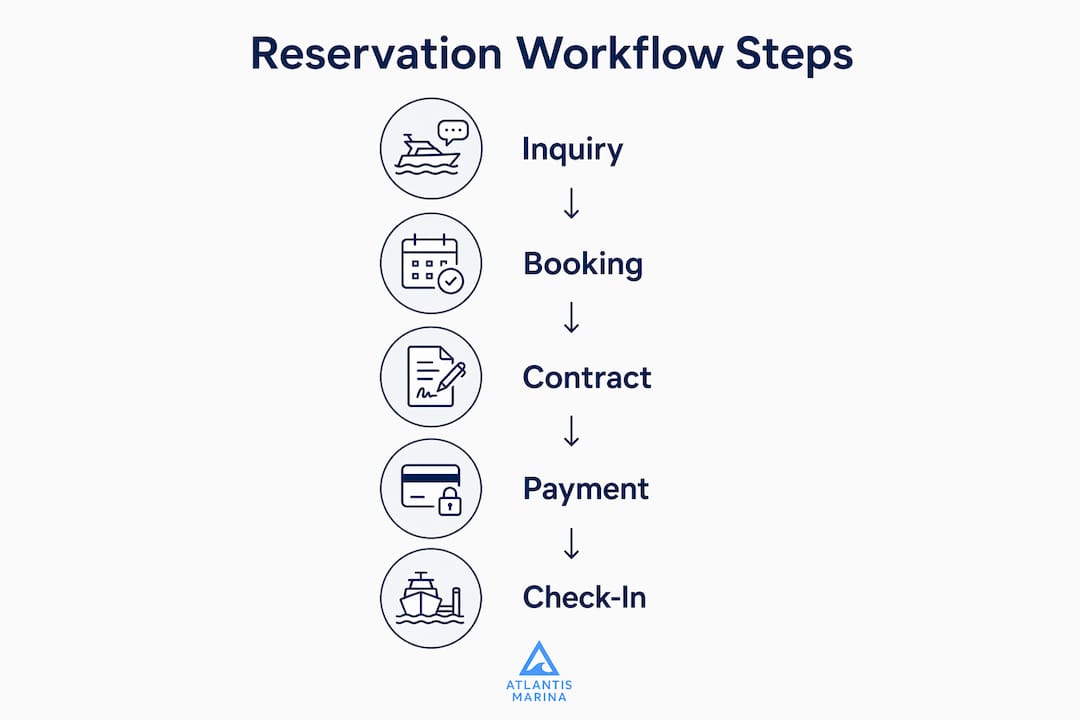
A unified platform reduces admin hours, eliminates double bookings, and speeds up guest check-in from inquiry to post-event reconciliation. Here is how that workflow runs on Atlantis Marina:
- Inquiry: A member or guest submits an event inquiry through the club's website via an Atlantis intake form. The lead is captured in the operations dashboard automatically.
- Online booking with deposit: The member selects the event space, date, and time through the Atlantis Boater App or web portal. A deposit is collected via Stripe or ACH at booking.
- Contract e-sign: Atlantis E-Sign sends the event contract to the member for digital signature. No paper, no back-and-forth email.
- Automated invoices and autopay: The platform generates invoices on schedule and charges the member's saved payment method automatically. Refunds and adjustments are processed in the same system.
- Check-in with Boater App: On event day, staff use QR-code workflows to check in guests. The Atlantis Boater App displays the member's reservation, payment status, and vessel details instantly.
- Post-event reconciliation and reporting: QuickBooks Online sync closes the billing loop. Occupancy and revenue reports are available in the dashboard for board review.
Feature highlights and the pain points they solve:
- Automated billing and e-sign: Eliminates manual invoice creation and paper contracts, which are the two biggest time sinks for event coordinators.
- QuickBooks Online sync: Removes the end-of-month reconciliation scramble that plagues clubs using disconnected payment tools.
- Atlantis Boater App: Members complete bookings, upload documents, and sign contracts without calling the dock office, cutting inbound call volume.
- Atlantis Bot: Answers common event questions on the club website 24/7, so staff handle only complex or high-value inquiries.
- Smart hardware integrations: Gate access and boat lift controls tied to reservations prevent unauthorized facility use during private events.
For premium events like weddings or full-club rentals, pair the digital booking workflow with a coordinator-managed phase for catering, vendor access, and setup logistics. The high-end amenity management approach works best when the platform handles the transactional layer and a human coordinator manages the experience layer.
Pro Tip: Set up Atlantis Bot to answer your top five event FAQs (pricing, capacity, catering policy, parking, cancellation terms) on your club website. This alone can cut pre-booking inquiry calls by a meaningful margin and lets your event staff focus on confirmed reservations.
Implementation notes: Migrate member records and existing reservation data in week two of the pilot. Train dock office staff on the operations dashboard before opening self-service to members. Pilot KPIs to track: double-booking rate, admin hours per event, and booking completion rate.
Key Takeaways
A unified, digital-first reservation workflow with member self-service and automated billing is the most reliable path to reducing admin overhead and eliminating double bookings at yacht clubs.
| Point | Details |
|---|---|
| Centralize above 30–50 bookings per month | Manual systems become failure points at this volume; a unified platform prevents double bookings and staff burnout. |
| Payments and QuickBooks sync are non-negotiable | Clubs without autopay and accounting sync carry significant manual reconciliation overhead every month. |
| Pilot in 6–12 weeks | A focused pilot covering one event type can go live in six weeks; multi-resource clubs typically need ten to twelve. |
| Regatta workflows need dedicated configuration | Crew rosters, launch windows, and volunteer assignments require event-type-specific setup, not generic scheduling. |
| Atlantis Marina as recommended platform | Atlantis Marina covers slips, events, billing, hardware, and member self-service in one platform; schedule a demo to scope your pilot. |
Immediate action plan:
- Audit your current monthly booking volume (especially if you regularly surpass 30–50 bookings per month) and identify the top three pain points (double bookings, manual invoicing, slow check-in).
- Schedule a vendor demo with Atlantis Marina and use the demo questions from the how-to-choose section above.
- Scope a 6–8 week pilot focused on your highest-volume event type.
The decisive move this month is to book a platform demo and define your pilot scope before the next event season begins.
Why unified workflows are the only real answer for yacht clubs
Clubs that treat event reservations as a standalone problem, solved with a scheduling add-on or a shared calendar, consistently run into the same wall: a booking confirmed in one tool, a payment collected in another, and a contract sitting in someone's email inbox. When a conflict arises, there is no single source of truth. Clubs regularly exceeding 30–50 bookings per month especially need a unified digital platform to reliably coordinate all aspects of event operations.
The clubs that get this right treat every event as a project record. Rosters, billing, volunteer coordination, and facility bookings are linked in the same platform, so a change in one place propagates everywhere. That is not a feature preference; it is the operational difference between a club that runs smoothly and one that relies on institutional memory and heroic staff effort.
Club leaders often underestimate the cost of fragmentation. The visible cost is a double booking or a missed payment. The invisible cost is the hours staff spend reconciling systems, chasing signatures, and answering questions that a self-service portal would handle automatically. A unified platform does not just save time on individual tasks; it removes entire categories of manual work from the weekly schedule.
The right system also protects club reputation. Events are central to member retention and non-member revenue. A guest who cannot complete an online booking, or who shows up to find their reservation unconfirmed, does not come back. Professionalizing the workflow is not a technology project; it is a service quality decision.
Atlantis Marina covers your full event reservation workflow
Atlantis Marina gives yacht clubs and marinas one platform for slip reservations, event booking, automated billing, smart hardware, and member self-service — replacing the patchwork of spreadsheets, email threads, and disconnected tools that slow down every event season.
The platform's billing automation handles deposits, autopay, e-sign contracts, refunds, and QuickBooks Online sync without manual entry. The Atlantis Boater App puts self-service booking, document uploads, and payment in members' hands. Atlantis Bot handles routine inquiries on your website around the clock. And smart hardware integrations tie gate access and boat lift controls directly to reservations.
Ready to see it in action? Schedule a demo to walk through a live event reservation workflow tailored to your club's size and event mix. You can also explore the full marina billing features to see how automated payments and QuickBooks sync work in practice.
Useful sources and further reading
- Atlantis Marina platform overview — primary product page covering platform capabilities, billing automation, and demo scheduling.
- Atlantis Boater App — detail page for the member-facing self-service portal covering reservations, contracts, and messaging.
- Atlantis Marina billing software — feature page for e-sign, autopay, Stripe/ACH, refunds, and QuickBooks Online sync.
- Benicia Yacht Club private events — real-club example of event pricing, seating capacity, and catering documentation.
- Harlem Yacht Club event planning — real-club example of dedicated event contacts and booking guidance.
- Daniel Island Yacht Club full-club rental — example of a professional-planner requirement and two-phase event workflow for premium rentals.
- Boater self-service portal guide — operator guidance on setting up member self-service for reservations and billing.
- Marina digital passes guide — covers QR-code check-in and digital ticketing for events and dock access.
During vendor demos, prioritize independent club references and live feature verification over marketing materials. Ask vendors to demonstrate conflict prevention, waitlist advancement, and QuickBooks sync with a live test booking before signing any contract.
FAQ
What is a yacht club event reservation workflow?
A yacht club event reservation workflow is the end-to-end process for booking, confirming, billing, and checking in guests for club events, covering everything from online inquiry to post-event reconciliation. A unified digital workflow connects reservations, payments, contracts, and reporting in one platform.
When should a yacht club move from manual to a digital booking system?
Clubs with higher monthly booking volumes find that manual spreadsheets and email become failure points, producing double bookings and staff burnout. At that volume, a centralized reservation platform pays for itself in recovered admin hours.
Does Atlantis Marina support regatta and race event workflows?
Yes. Atlantis Marina supports crew registration, launch window scheduling, volunteer rostering, QR-code check-in, and smart hardware integrations for dock and lift access, making it suitable for both racing events and large social functions.
How long does it take to implement a new reservation workflow?
A focused pilot covering one event type typically takes 6–12 weeks, depending on the number of integrations and the volume of historical data to migrate. Clubs with clean member records and a single event type can go live in six weeks.
What integrations are non-negotiable for yacht club event reservations?
Stripe or ACH for online payments, QuickBooks Online for accounting sync, and a two-way calendar integration for conflict prevention are the minimum required integrations for a production-ready event reservation workflow.